
Choosing Maths Tuition in Hounslow: Questions Parents Should Ask
Maths is one of the subjects parents most often ask about. Whether your child is struggling with fractions, wants more challenge, or is heading towards the KS2 SATs or GCSEs, finding the right maths tuition in Hounslow starts with knowing what to look for. This guide sets out the questions worth asking any tutor or centre, so you can compare options with confidence.
Work out what kind of maths help your child needs
Different stages call for different support:
- Years 1 and 2: secure number sense, counting, place value and early addition and subtraction.
- Years 3 to 6: fluent times tables (the national curriculum expects pupils to know them up to 12 × 12 by the end of Year 4), written methods, fractions and reasoning. Year 4 pupils also take the multiplication tables check, and Year 6 pupils sit the KS2 SATs in May.
- Years 7 to 9: algebra, ratio and proportion, geometry and handling more abstract ideas.
- Years 10 and 11: GCSE Maths, with Foundation or Higher tier papers and a grade between 1 and 9.
Ask your child’s teacher which topics are causing difficulty. Specific gaps are much easier to fix than a general sense of “being bad at maths”.
Centre, private tutor or online?
A tuition centre offers structure, a regular routine and often a lower cost per session. A private tutor can follow your child’s pace more closely, which suits specific gaps or short-term goals. Online tuition is flexible but depends on your child’s ability to concentrate on a screen. Think about which setting your child is most likely to enjoy and stick with. For many children, a small group offers a good balance of individual attention and the motivation that comes from learning alongside others.
Questions to ask a maths tutor or centre in Hounslow
- How will you find out where my child is starting from? Look for an initial assessment that identifies gaps, not just a general chat.
- How do you teach understanding, not just methods? Good maths teaching explains why a method works, using visual models and worked examples.
- How much time is spent practising? Confidence comes from doing questions, not watching explanations.
- How do you build times tables and number fluency? This underpins almost everything else in maths.
- How do you teach problem-solving? Exams increasingly test reasoning, not only calculation.
- For GCSE, which exam board and tier do you teach to? AQA, Edexcel and OCR have different papers and different formula provision.
- How is homework set and checked?
- How will I know my child is improving? Ask for examples of the feedback parents receive.
- What is the group size? Smaller groups usually allow more individual attention.
- Can my child try a session first?
Practical points for Hounslow families
Think about the weekly routine as well as the teaching. Weekend sessions leave school evenings free for homework and rest, but they need to fit around other family commitments. Check the travel time, whether there is parking, and whether the session length suits your child’s concentration. The government’s guidance for parents on out-of-school settings is also a helpful reference when asking about safeguarding.
Signs that maths tuition is working
- Your child talks about maths with more confidence and is less likely to say “I can’t do it”.
- Homework gets done with less stress, and they ask for help in a more specific way.
- They can explain how they reached an answer, not only what the answer is.
- Teacher comments, class tests or assessment results show steady improvement over weeks and terms rather than overnight.
- The tutor can point to particular topics that have moved from shaky to secure.
Progress takes time and is rarely a straight line, so look for a steady direction of travel and ask the tutor for regular, specific feedback.
How to support maths at home
Tuition works best alongside small habits at home. A few minutes a day of times tables or number facts is more effective than one long session each weekend. Point out maths in everyday life, such as cooking, shopping, travel times and sport scores. Praise effort and the strategies your child uses, and avoid saying “I was never good at maths”, because children pick up on that. Asking your child to explain a problem to you is a good way to check understanding and build confidence. If homework turns into a battle, stop, take a break and tell the tutor or teacher what happened.
Maths at the Zyzaa Tuition Hounslow centre
Our Hounslow centre runs every Saturday morning, from 9:30am to 1:30pm, at The Heathland School on Wellington Road, with parking on site. Classes typically hold six pupils, with a maximum of eight, and children are grouped so that they work at a similar level. Our Maths tuition focuses on building confidence through explanation, practice and problem-solving, following the National Curriculum, and at GCSE the AQA, Edexcel and OCR specifications. Lessons begin with a free assessment to identify strengths and gaps, and homework, assessments and feedback help track progress.
Fees are monthly, from £120 for Years 1 to 6 (two subjects); see our pricing page. For full details of the centre, directions and timetable, visit our Hounslow centre page.
Key takeaways
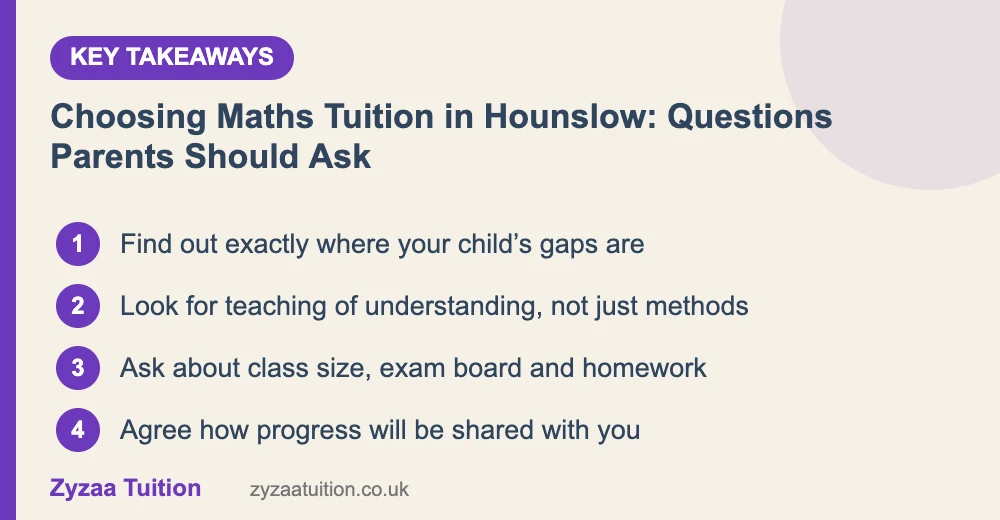
The best maths tuition in Hounslow starts with finding your child’s gaps, teaching understanding and giving you regular feedback.
Want to see how maths is taught at our Hounslow centre? Book a free assessment and choose Hounslow as your preferred centre.
