
How to Use GCSE Past Papers and Mark Schemes Effectively

Past papers are one of the most useful revision tools for GCSE students, and one of the most misused. Used well, they show you exactly what the exam looks like, expose the topics you need to work on and build the stamina and timing you need on the day. Used badly, they become a way of feeling busy without improving. This guide explains how to use GCSE past papers and mark schemes effectively.
What past papers can and cannot do
Past papers tell you what the examiners ask and how they award marks. They do not teach you the content. If you attempt a full paper before you have learned the material, you will mostly find out what you do not know, which is useful but demoralising if repeated too early. The best approach is to learn a topic first, practise questions on it, and use full papers to test how well everything fits together.
Find the right papers
Exam boards publish past papers and mark schemes free of charge. Make sure you use the right ones:
- The right board. Check with your teacher whether your school uses AQA, Pearson Edexcel or OCR, and sometimes a different board for different subjects.
- The right tier and specification. Maths and some sciences have Foundation and Higher tier papers. GCSEs were reformed and graded 9 to 1 from 2017, so avoid older papers graded A* to G because the content and style differ.
- The official source. Use the boards’ own pages: AQA, Pearson Edexcel and OCR.
A step-by-step method
- Learn first. Revise the topic using notes, flash cards and retrieval quizzes.
- Start with topic questions. Pick questions on one topic from several papers. This builds confidence and shows what is commonly asked.
- Do a section or a paper untimed. The first time you try a full paper, take your time and use your notes if you need to. The aim is to understand the demands.
- Move to timed practice. Closer to the exam, work under exam conditions: no phone, the right equipment, the correct calculator or non-calculator rules and the real time limit.
- Mark it honestly. Use the mark scheme and a different colour pen. Do not award marks you have not earned.
- Review every mistake. This is where most of the learning happens (see below).
- Redo similar questions a few days later. Spacing the practice helps you remember and shows whether the fix has stuck.
How to read a mark scheme
A mark scheme is not just an answer key. It shows how marks are earned and what the examiner is looking for:
- Method marks and accuracy marks. In Maths and Science calculations, you can earn marks for a correct method even if the final answer is wrong, which is why showing your working matters.
- Acceptable alternatives. Notice the different ways of expressing a correct answer.
- Command words. “State”, “describe”, “explain” and “evaluate” ask for different things. Compare your answer with what the mark scheme rewards.
- Levels of response. For extended answers in subjects such as English, History and Geography, marks are awarded by level. Look at what moves an answer from one level to the next.
Most exam boards also publish examiner reports for past series. They describe common errors and what strong answers did, which is valuable for understanding where marks are lost.
Learn from your mistakes
For every lost mark, ask why you lost it and record it in an error log. Typical reasons are:
- a knowledge gap, where you did not know or could not remember the content;
- a misread question, where you answered a different question from the one asked;
- a careless slip in arithmetic, units or copying;
- poor timing, where you ran out of time or spent too long on a low-mark question; or
- a technique problem, such as not using evidence or not linking back to the question.
Each type needs a different fix. Knowledge gaps need relearning, misreading needs a habit of underlining key words, and timing needs practice under time pressure. A short, specific note, such as “forgot to convert to standard form”, is more useful than “do better”.
How many papers, and when?
There is no magic number. A few papers done carefully and reviewed thoroughly are worth far more than a pile of papers marked quickly. In the final weeks before the exams, many students find one full paper a week, plus targeted practice on weak topics, a sustainable pattern. Try to keep a few recent papers back to use as realistic practice nearer the exam, and avoid memorising the answers to papers you have already seen.
Using grade boundaries sensibly
Grade boundaries change each year, depending on the difficulty of the paper, so a mark that gets a grade 5 in one year may be different the next. Use them as a rough guide only. A better target is to improve the number of marks you pick up on each type of question.
Subject-specific tips
- Maths: practise non-calculator papers separately, show all your working and check answers with an estimate.
- English: plan extended answers briefly, practise timing for each question and ask your teacher or tutor to give feedback on your writing, because it is hard to mark yourself objectively.
- Science: practise the longer, extended-response questions, learn the key terms and equations and know the required practicals.
How tuition can help
If you keep losing marks on the same type of question, or you are not sure how to interpret a mark scheme, a tutor can help. In our GCSE classes we teach to the AQA, Edexcel and OCR specifications and use exam-style questions with regular feedback, so students learn how marks are awarded. If you are working on Maths, see our guide to creating a GCSE Maths revision plan.
Key takeaways
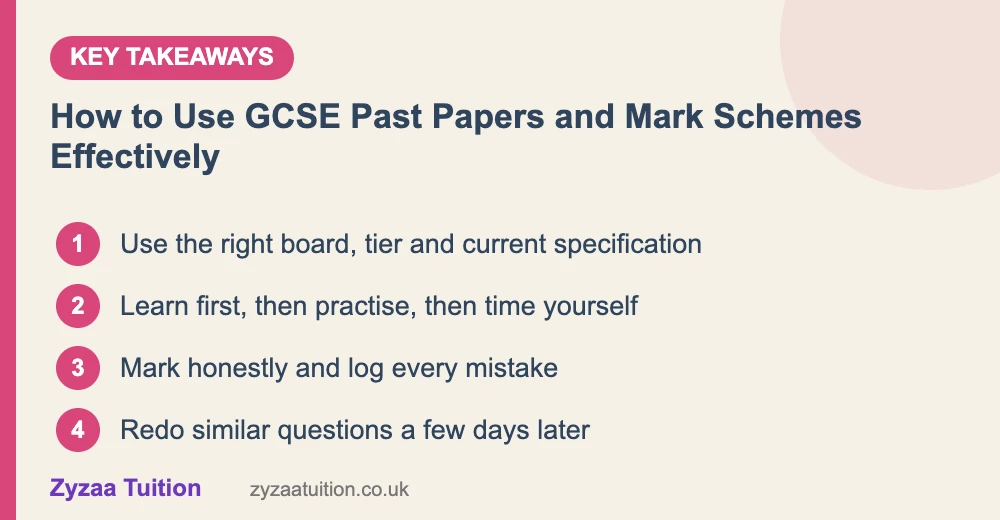
Use GCSE past papers after you have learned a topic, mark them honestly with the mark scheme and learn from every lost mark.
Need help turning practice into progress? Book a free assessment and we will show you where your child is losing marks and how to fix it.
