
How to Establish a Homework Routine That Works for Your Family

Homework can turn into the least popular part of the day. Reminders become arguments, tasks drag on and everyone ends up tired. A consistent routine will not make homework fun, but it usually makes it calmer, quicker and less of a battle. This guide explains how to set up a homework routine that works for your family, and how to build your child’s independence over time.
Why a routine helps
When homework happens at the same time and in the same place each day, it stops being a daily negotiation. Children know what to expect, and the habit of starting without being asked grows with repetition. A routine also encourages the planning and self-checking skills that help children learn independently, which the Education Endowment Foundation’s guidance on metacognition and self-regulated learning identifies as important for progress.
Set up a suitable space
- Quiet and well lit. A table is fine; it does not need to be a desk or a bedroom.
- Everything to hand. Keep pens, pencils, a ruler, a calculator, paper and a dictionary in a box so that no time is lost searching.
- Phones out of reach. Notifications are the biggest distraction, for younger children and teenagers alike. Keep devices in another room unless they are needed for the task.
- Age-appropriate supervision. Younger children often work best at the kitchen table where you can see how they are getting on. Older children may prefer their own space, with agreed rules and a check-in at the end.
Choose the right time
There is no perfect time, but there are a few good principles. Allow a short break and a snack after school before starting, but do not leave it so late that your child is exhausted. Choose a time that works around clubs and family commitments, and keep it as consistent as you can. Follow the school’s guidance on how long homework should take; as a rough guide, primary-aged children usually work best in short sessions of 10 to 20 minutes plus reading, while secondary students may need longer, split into sessions with breaks. If homework regularly takes much longer than the school expects, tell the teacher.
Make a simple plan
- Check the homework diary or planner and list what needs doing and when it is due.
- Decide the order. Some children do best starting with the hardest task while they are fresh. Others prefer an easy win to build momentum. Let your child choose when possible.
- Work in short blocks. Twenty-five minutes of focus followed by a five-minute break is a popular pattern for older children. For younger ones, shorter blocks are better.
- Break big tasks into smaller steps, such as planning, writing a first draft and checking, and spread them across several days.
- Tick things off. Seeing the list shrink is motivating.
Reduce distractions
Agree the rules together: phones and tablets away, television off, and siblings playing elsewhere if possible. If your child needs a computer, close other tabs and use a focus mode if the device has one. Quiet background music without lyrics helps some children, but not all, so test what works.
Your role: support, don’t take over
- Be available to help, but let your child do the thinking. Ask questions such as “What is the question asking?” and “What have you tried so far?” instead of giving answers.
- Praise effort and persistence, not just correct answers.
- Check that the work is complete, but avoid correcting every mistake. Teachers learn more from seeing what your child can really do.
- If homework regularly brings tears, or is consistently too hard, talk to the teacher. It may signal a gap that needs attention.
When your child resists
Stay calm and acknowledge the feeling: “I can see you’re tired, and you’d rather be doing something else.” Then return to the routine. Offering limited choices, such as which subject to start with, gives your child a sense of control. Consistent follow-through, such as screen time after homework, is more effective than negotiating each day. If resistance is persistent, look for the underlying cause: difficulty with the work, worry about getting it wrong, tiredness or something that happened at school.
Build independence gradually
Think of it as a ladder: first you work with your child, then you sit nearby, then you check at the end, and finally they manage on their own and ask for help only when they need it. Encourage them to plan their evening, estimate how long each task will take and check their own work before they show you. Each step makes the move to secondary school easier.
Sample routines
- Primary: snack and a break; 15 minutes of homework at the kitchen table; 10 minutes of reading; then free time.
- Secondary: snack and a break; check the planner and make a short list; two or three 25-minute blocks separated by short breaks; pack the bag for tomorrow.
When extra help makes sense
If homework is taking much longer than it should, or your child has gaps that make it hard to complete independently, extra support can help. At Zyzaa Tuition, homework forms part of our primary and secondary programmes, and our tutors give feedback so that you can see how your child is getting on. Our FAQs explain how lessons, homework and progress feedback work.
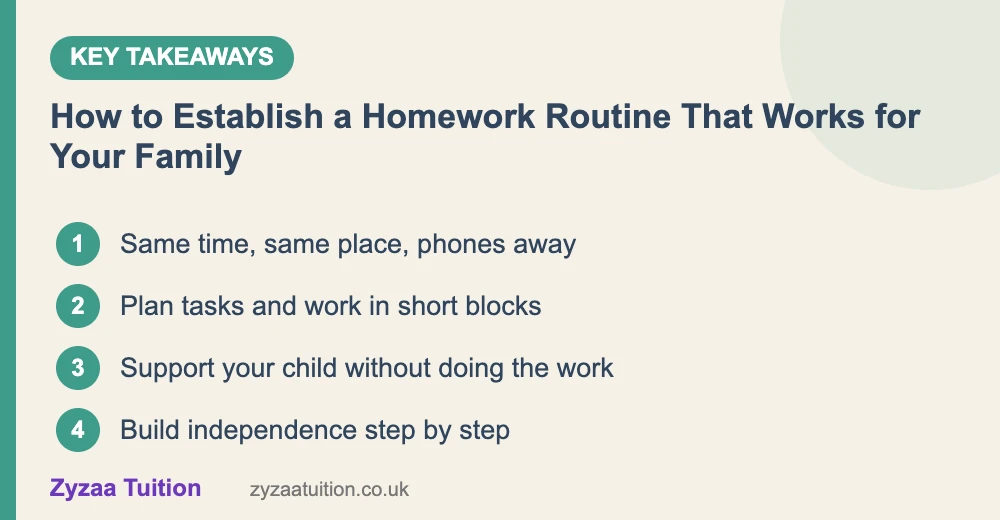
Key takeaways
A good homework routine means the same time and place each day, fewer distractions and growing independence.
Is homework a daily struggle? Book a free assessment and we will help you work out whether gaps in understanding are the cause.
