
How to Build a Realistic GCSE Revision Timetable

A GCSE revision timetable can be a lifesaver or a source of guilt. The pretty colour-coded plan that takes hours to create and collapses after three days does more harm than good. The best timetables are realistic, flexible and built around how students actually learn. This guide shows how to build a realistic GCSE revision timetable you can stick to.
Gather the information first
- Exam dates. Get the full timetable from your school or exam board, including the order of papers.
- Your fixed commitments. School, clubs, family time, work or religious observance, and sleep.
- Your subjects and topics. List each subject’s topics, using the exam board’s specification as a checklist.
- Your starting point. Rate each topic red, amber or green based on recent tests and mock exams.
Five principles of a good timetable
- Prioritise. Spend more time on weak topics, larger topics and subjects with earlier or more demanding exams.
- Little and often. Returning to a topic several times over weeks helps you remember it far better than one long session.
- Mix subjects. Two or three different subjects in an evening keeps you fresher than several hours of the same one.
- Use active methods. Retrieval practice, such as flash cards, quizzes and blank-page recall, is more effective than re-reading.
- Plan rest. Breaks, free time and sleep are part of the plan, not a reward for finishing it.
Step by step
- Work backwards from the exams. Count the weeks between now and your first exam, and mark key dates, such as mocks.
- Block out the fixed commitments first. What is left is the time you really have.
- Choose realistic session lengths. Thirty to forty-five minutes of focused work, followed by a break of five to ten minutes, suits most students. Be honest about how many sessions you can manage on a school night.
- Assign topics to sessions. Give red topics more sessions, and place them earlier. Include short sessions for greens so that they stay fresh.
- Schedule review. Add a weekly session to revisit earlier topics and go through your mistake log.
- Add past papers later. Begin with topic questions, and add full timed papers as the exams approach. Our guide to using past papers and mark schemes explains how.
- Protect sleep and rest. Most teenagers need around eight to ten hours of sleep a night, according to the NHS, and a late-night revision session usually backfires. Keep at least one half-day a week free.
A sample school-term week
This example assumes about an hour and a half of revision on weekday evenings, and more at weekends. Adjust it to your situation.
- Monday: Maths topic (40 minutes), break, English quotation recall (30 minutes).
- Tuesday: Science topic (40 minutes), break, flash cards for another subject (30 minutes).
- Wednesday: A weaker subject (40 minutes), break, short mixed quiz (30 minutes).
- Thursday: Maths practice questions (40 minutes), break, weekly review of the mistake log (30 minutes).
- Friday: Rest, or one light session.
- Saturday: Two or three 45-minute sessions with breaks, including a past-paper section.
- Sunday: One longer session, such as a timed paper, and then time off.
Easter and study leave
Longer days can feel liberating, but they need structure too. Plan a morning and an afternoon block, with a long lunch and an evening off. A few focused hours are better than a day of half-attention. Keep mixing subjects, and use the time for past papers and for working on the topics you have marked red.
Stay flexible
Review your timetable every week. Which sessions did you complete? Which topics have moved from red to amber? What needs more time? If you fall behind, do not abandon the plan. Drop the least important sessions, and carry on. A timetable that adapts is far more useful than a perfect one that you give up on.
Common mistakes
- Filling every hour, with no allowance for tiredness or the unexpected.
- Giving most of the time to favourite subjects.
- Making the timetable the main task, instead of the revision itself.
- Forgetting to build in review and past papers.
- Comparing your plan with friends’ plans. Everyone’s situation is different.
Getting help
If you are unsure what to prioritise, or you find it hard to stay on track, a tutor can help you build and review a plan. Our GCSE tuition covers Maths, English, Biology, Chemistry and Physics in small groups. For a subject-specific plan, see our guide to a GCSE Maths revision plan.
For free revision resources by subject, see BBC Bitesize.
Key takeaways
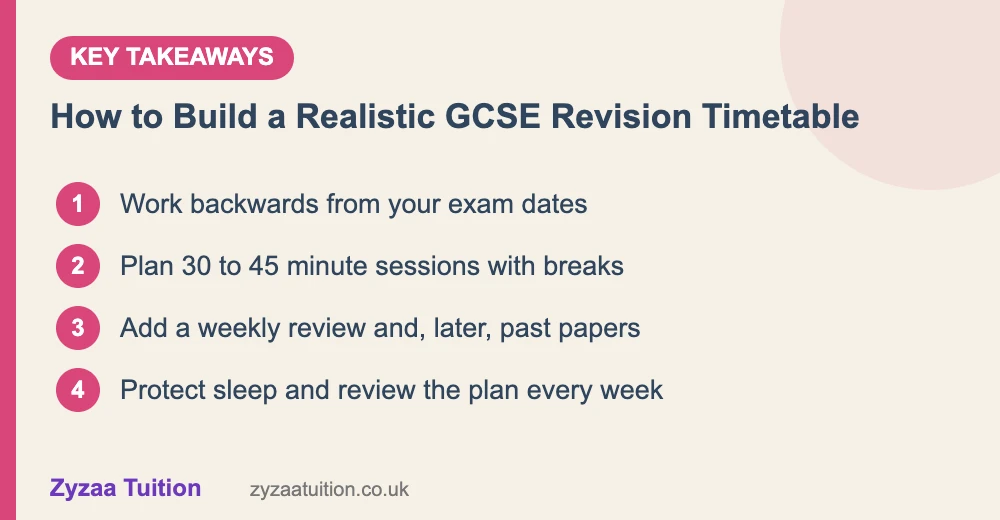
A realistic GCSE revision timetable starts from your exam dates, prioritises weak topics and builds in rest.
Common questions
When should GCSE revision start?
There is no single date. Many students start building good habits in Year 10 and begin more structured revision well before the Year 11 mock exams. The earlier you start, the more you can spread the work into small, manageable chunks.
How many hours a day should I revise?
Quality matters more than quantity. On school days, an hour or two of focused work is realistic for many students, with longer but well-structured days in the holidays. Take breaks, and protect sleep.
What if I have fallen behind my plan?
Do not scrap it. Re-plan from today, prioritise the topics with the biggest gaps and the most marks, and drop the least important tasks. Talk to your teacher if you are unsure what matters most.
Need help building a plan that works? Book a free assessment and we will help you decide what to prioritise.
